APPAREL FIELD NOTES / 02
How to Choose an Alien T-Shirt Size Before You Order
The design can be their kind of weird. Check the garment before guessing the size.
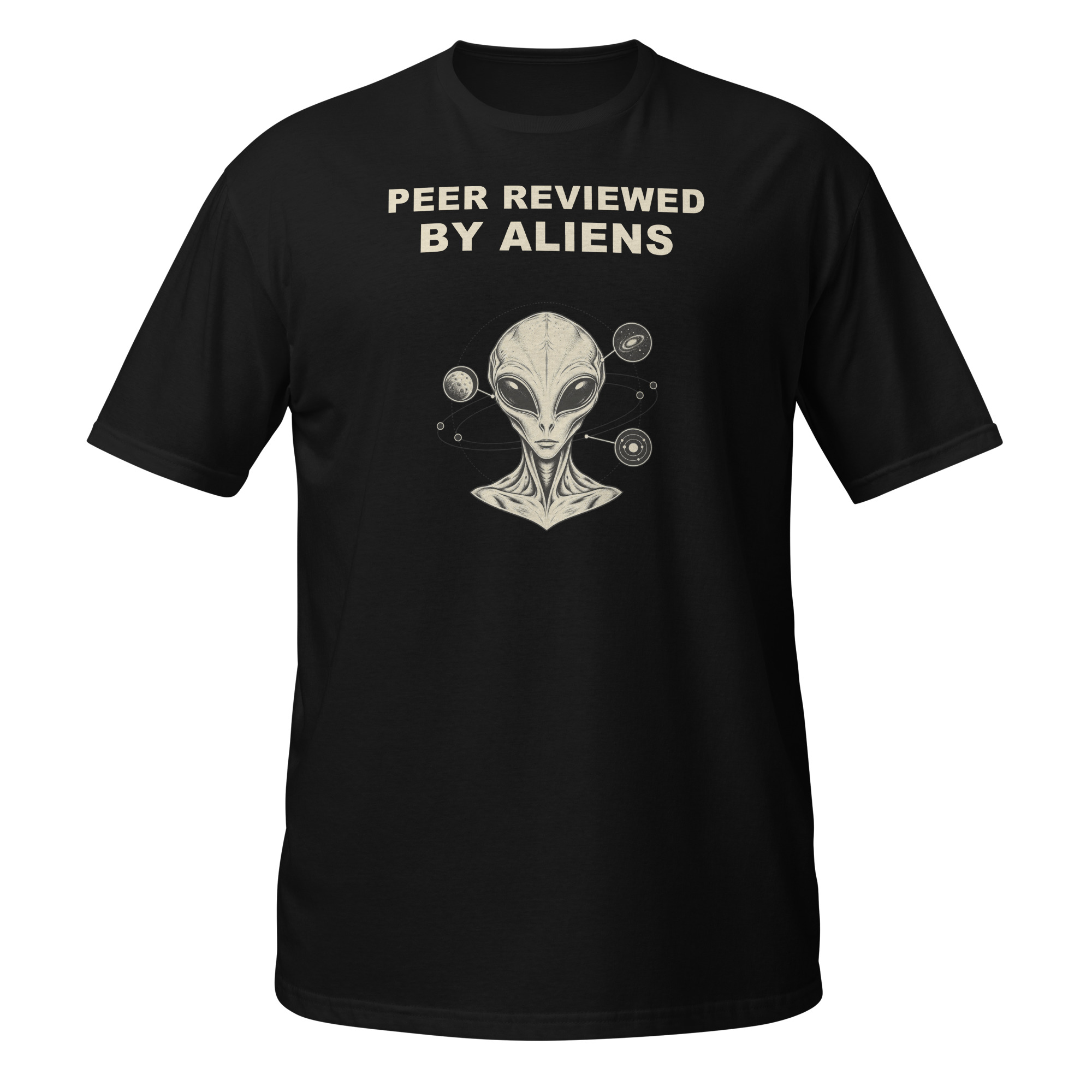
The saucer on the shirt is perfect. The Medium in your cart is a guess. Before you commit, put a tee you wear every week on the kitchen table and check its width and length against the exact product chart.
If you want more room but like where your current hem lands, look for extra width without extra length. A bigger letter can change both. You’re shopping for a shirt, not applying for an upgrade to a larger spacecraft.
Two shirts, two different fit decisions
Here's a hypothetical comparison using garment measurements taken flat. Your favorite tee is 20 inches wide and 27 inches long. Candidate A's chart says 20 inches wide and 29 inches long. Candidate B says 21 inches wide and 27 inches long. Those are teaching figures, not measurements from an Offworld Neighbors product.
Candidate A matches the width but adds two inches of length. Candidate B adds an inch of width while keeping the familiar length. If you want a little more room without a longer hem, B is the one to investigate. Check its sleeve and shoulder shape before deciding. The familiar letter on the label can't answer those questions for you.
If the actual chart leaves a crucial measurement unclear, ask before ordering. Interstellar mystery is fun on a shirt. Less fun in the fit.
When neither size copies your favorite shirt
Sometimes the next size adds room exactly where you do not want it. Humans, unlike convenient product diagrams, do not expand evenly in all directions. Here is a second hypothetical comparison, again using flat garment measurements rather than body circumference.
Your reference is 21 inches wide and 28 inches long. Candidate Small is 20 by 27; Medium is 22 by 29. Small loses an inch in both directions. Medium adds an inch in both. These are teaching figures, not an Offworld Neighbors size chart.
If you want more room and can use the extra length, investigate Medium. If the 28-inch hem is essential and the reference width already feels right, neither row resolves the choice. Compare another garment or ask for the fit detail that matters. Write “one inch wider and one inch longer” beside Medium so the tradeoff stays visible. The larger letter does not make the longer hem disappear.
Ask about the dimension that would change your choice
For that second hypothetical comparison, a useful store question is: “My comfortable tee measures 21 inches across and 28 inches long when laid flat. Your Medium chart shows 22 by 29 inches. Are those flat garment measurements, and what measurement tolerance should I allow for this exact style? I want the extra width but would prefer not to add length.” Include the product URL and selected style so the answer refers to the shirt you are considering.
The reply may clarify the comparison without producing a perfect match. If the extra length is still wrong for you, keep looking rather than treating a tolerance as a promise of a shorter shirt. The mission is a comfortable fit, not winning an argument with a size chart.
Start with the exact shirt, not the slogan
The slogan tells you which joke you are buying. It does not tell you how the garment fits. Short sleeves, long sleeves, everyday tees and heavyweight tees can use different blanks. Open the exact listing and keep its product URL beside your measurements.
The Peer Reviewed by Aliens Everyday Tee identifies a Gildan 64000; the heavyweight version is a different garment. A size you liked in one is a starting clue for the other, not a completed comparison.
Describe the fit the person wants
Ask what makes the favorite shirt a favorite: room across the chest, a shorter hem, sleeves that do not cling, or enough space for a layer underneath. “Relaxed, but no longer than this one” is a much better brief than “usually a medium.”
Check length and width separately. Being tall does not tell you how much room someone wants across the chest, and a model photo cannot supply measurements that the listing leaves out.
Measure a shirt they already like
With the wearer's permission, use a clean, familiar shirt as a reference. Follow the measurement method in the candidate product's size guide. If that guide describes garment measurements taken flat, place the reference shirt on a flat surface, smooth it without stretching it, and measure the same points.
Record both the number and the method. A flat width from one side of the shirt to the other is different from a measurement around a person's body. Do not put those numbers in the same column and treat the comparison as complete.
Measure the reference shirt's length and any other dimensions the candidate guide provides. If the two guides define a measurement differently, ask for clarification before selecting the size. A careful comparison is more useful than a confident guess.
A worn favorite may have a stretched neckline, twisted seam or uneven hem. Note that before treating it as a precise target. Another shirt you wear comfortably can give a cleaner reference. Its familiar fit matters more than proving that an exhausted old tee still deserves field duty.
Keep the units consistent
Keep the units beside every number. Printful supports metric and imperial size guides, so read the unit on the exact chart you are using. If you convert a figure, keep the original too; heavy rounding can hide a meaningful difference.
Check the artwork without treating it as a ruler
Use the product images to decide whether you like the design, placement and color combination. Do not measure the print or infer garment dimensions from a styled photograph or mockup.
Printful explains that print size is not generally scaled for every garment size, although some products use downscaling for smaller sizes. That is a reason to check the specific product rather than assume every size shows the artwork at the same proportion.
Source: Printful: design scaling across garment sizes.
The useful choice is the garment fit plus the artwork you want. A smaller shirt is not a reliable way to request a smaller illustration, and a larger shirt is not a request to enlarge the design.
Review care before choosing the fit
Read the actual care information before choosing. Buying a loose shirt and hoping a hot wash will tailor it is an ambitious assignment for a washing machine. It can also affect the print.
Your washed reference tee tells you what you enjoy wearing now. It does not establish how a different new garment will shrink. Follow the new garment label and ask about any missing care detail.
Use a short size comparison sheet
Keep one row for each candidate. The goal is to make the decision understandable without collecting private body information you do not need.
| Check | What to record | What to resolve before buying |
|---|---|---|
| Exact garment | Product URL, style and color | Is this the version you compared? |
| Preferred fit | Close, relaxed or deliberately roomy | Does the wearer agree? |
| Reference measurement | Value, unit and measurement method | Is it garment width or body circumference? |
| Candidate size | Chart values for width and length | Are the methods comparable? |
| Product uncertainty | Missing dimensions or stated tolerance | Does the store need to clarify it? |
| Final selection | Chosen variant and current order status | Does the cart retain the intended size? |
Do not fill an unanswered row with the size the person “usually wears.” Treat that familiar size as context, then use the exact chart to review the purchase.
If you cannot verify a gift size
A surprise gift does not have to be a clothing-size gamble. Consider a mug, tote or another useful format when the recipient's garment preference is unknown. Check the dimensions, care and current ordering status for that product too.
Our alien gift selection guide explains how to match a gift to the person's interests and routines. Use that process if the design is right but the shirt comparison is still unresolved.
Before placing an order, check the selected variant, shipping information and return policy. Do not assume that a size mistake qualifies for a free exchange or that a holiday arrival date is guaranteed.
Choose the design and the garment together
Compare the everyday Peer Reviewed tee, the heavyweight version, and the Carbon-Based. Mostly. jersey tee against the same reference shirt. Keep each garment’s own chart with its row.
Choose one candidate and complete the comparison with the wearer. If a crucial measurement is missing, ask through our contact page. The goal is a shirt they will reach for, not a label that happens to sound familiar.
MAKE A CLEAR CHOICE